






Handheld Ultrasound Accuracy: How Reliable Is It Really?
- 2026-09-23
- 69
- Guangzhou Sonostar Technologies Co., Limited
"Can I trust it?" is the first question most buyers ask about a handheld ultrasound, and the honest answer is more nuanced than a simple yes or no. Published research provides a useful baseline: a randomized clinical trial comparing a handheld point-of-care device with a cart-based system reported similar diagnostic accuracy (89.3% vs. 92.5%), and a systematic review found good overall agreement between hand-held and high-end systems across multiple clinical settings. Reliability, however, is not a single number. It splits into two questions — whether the image truly represents tissue, and whether measurements are repeatable — and each depends on different factors. This article walks through both, plus how to verify a device before purchase.
What "Accurate" Means for a Handheld Ultrasound
Accuracy is often treated as one concept, but in practice it is two. Image accuracy asks whether the displayed cross-section faithfully reflects the tissue being scanned — detail, resolution and freedom from obvious artifacts. Measurement accuracy asks whether lengths, areas or flow values derived from the image are consistent between repeated scans and comparable to other devices. Confusing the two produces vague conclusions. Judging whether a specific device is reliable means answering each separately.
What the Research Says
Evidence on handheld ultrasound accuracy has grown rapidly. A randomized clinical trial found that a portable handheld device achieved diagnostic accuracy of 89.3% versus 92.5% for a cart-based model, leading the authors to conclude that the diagnostic accuracy of handheld POCUS is similar to that of a traditional cart-based system. A systematic review of hand-held versus high-end ultrasound systems reported good overall agreement in the settings examined, including urology applications such as kidney length, residual bladder volume and prostate volume. A feasibility study on muscle thickness measurement found that even novice operators obtained acceptable measurements with a handheld device, with near-perfect reproducibility between two operators for a given system.
One consistent finding deserves attention: operator experience affects reliability. A study of median nerve measurements reported excellent intra-operator reproducibility for an expert (ICC above 0.80) but only moderate reproducibility for a novice. The device is capable; the operator's skill determines how consistently that capability is expressed.
How Hardware Determines Image Accuracy
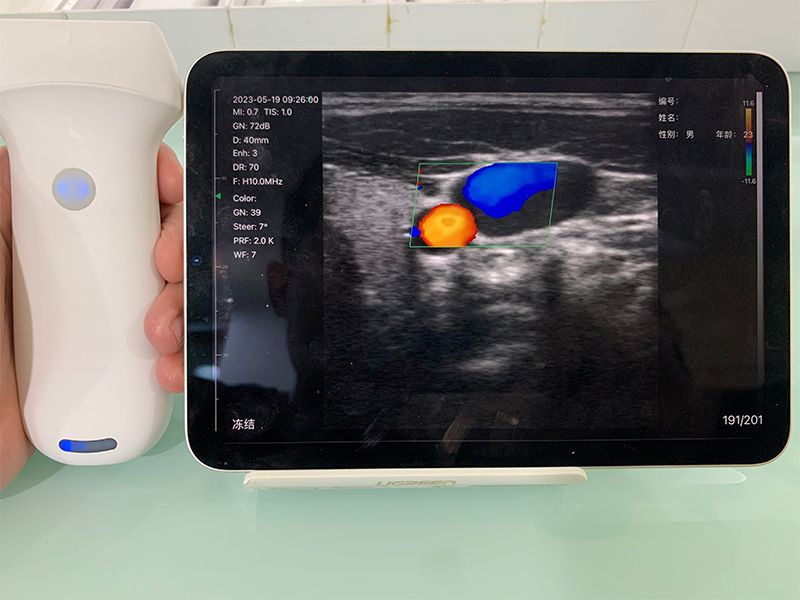
Image fidelity starts with the transducer. Element count, channel count and frequency must match the anatomical target. More elements and channels generally mean richer detail; frequency determines whether near-field structures are resolved clearly or deeper tissue is reached. In SonoStar's lineup, linear-array probes use 192 elements and 64 channels with frequencies of 10/13.2 MHz, suited to thyroid, small parts and superficial vascular work, while convex probes target deeper abdominal views. This is why hardware specifications matter: a probe that is well matched to the intended application produces trustworthy images, and one that is mismatched — however good on paper — will not.
Why Measurement Repeatability Matters More Than You Think
Image quality and measurement reliability are not the same thing. Manual caliper placement varies with hand position and technique; different operators, or the same operator on different days, can produce slightly different values. Automated measurement features reduce this variability by removing the manual step. SonoStar models with automatic vessel measurement, for example, read vessel diameter and flow parameters directly from the spectrum, limiting the operator-dependent component. A practical way to assess repeatability during evaluation is to measure the same target several times and observe the spread of results — a more direct test than any specification sheet.
How to Verify Accuracy Before You Buy
Three checks are worth doing on site:
Scan your own most common application. Put the probe on the anatomy you will actually examine and confirm the image is real and usable.
Repeat the same measurement. Take the same target and measure it several times; stable results indicate good repeatability.
Compare against a reference device if available. Same-site comparison with an existing cart-based system gives a concrete sense of agreement.
These three steps turn "is it accurate?" from a marketing question into a measurable one.
Reliability Extends Beyond the Device
Accuracy is only part of reliability. Regulatory status, training support and after-sales service determine whether the device remains dependable in daily use. An unregistered device is a compliance risk regardless of its specifications; without proper training, even an accurate probe will underperform in untrained hands. Evaluate the hardware, then evaluate the manufacturer.
Frequently Asked Questions
Is a handheld ultrasound as accurate as a hospital cart-based machine?
In a randomized trial, diagnostic accuracy was 89.3% for a handheld device versus 92.5% for a cart-based model — similar enough that the authors described handheld POCUS accuracy as comparable. Agreement varies by application and operator skill.
Can a novice use a handheld ultrasound reliably?
Studies show novices can obtain acceptable measurements with proper training, but repeatability is stronger for experienced operators. Automated measurement features help reduce operator-dependent variability.
What determines handheld ultrasound image quality?
Element count, channel count, frequency and how well the probe matches the intended application. A linear probe suited to superficial structures will not perform like a convex probe on deep abdominal views.
How can I test accuracy before purchasing?
Scan your most common application, repeat the same measurement several times, and compare against a reference device if available.
Trust, Verified
"Reliable" is not a claim a manufacturer makes; it is a property you verify. Image accuracy comes from hardware matched to the task; measurement reliability comes from repeatable measurement logic and consistent technique; long-term dependability comes from regulatory compliance, training and service. SonoStar wireless probes carry the relevant medical device registration, use 192-element, 64-channel arrays across linear and convex types, support automatic vessel measurement, and are exported to more than 100 countries — a practical benchmark when you evaluate handheld ultrasound accuracy for your own setting.
References
Diagnostic Accuracy of a Handheld Ultrasound vs a Cart-based Model: A Randomized Clinical Trial — PMC11000544
Hand-Held Ultrasound Devices Compared with High-End Ultrasound Systems: A Systematic Review — PMC6628329
Reproducibility and Feasibility of a Handheld Ultrasound Device Compared to a Standard Ultrasound Machine in Muscle Thickness Measurements — PMC10030094
Reliability of Ultrasound Measurements of the Median Nerve Using a Handheld Device — PMC11175092
- Pre:How Long Does a Handheld Ultrasound Battery Last?
- Next:No more



 Home
Home Product
 News
News Contact