






What Is POCUS and Why Has a Wireless Ultrasound Scanner Become Its Defining Tool?
- 2026-09-16
- 83
- Guangzhou Sonostar Technologies Co., Limited
If you follow ultrasound, one acronym has gone from niche to mainstream almost overnight: POCUS — point-of-care ultrasound. The market was about USD 4.2 billion in 2025 and is projected near USD 9 billion by 2035, roughly 8% growth a year. Behind that boom is a shift in how clinicians work, and the enabler is not a new cart — it is a wireless ultrasound scanner that fits in a coat pocket.
What Is POCUS, and Why Is It Growing So Fast?
POCUS means acquiring and interpreting ultrasound where care happens — bedside, resuscitation bay, ward — and deciding immediately, rather than scheduling a formal scan in radiology. It is a work style, not a machine.
Three forces drive it. Imaging has become portable: pocket devices open in seconds and stream to a phone or tablet. Leading societies define a limited, checklist-based set of core applications (ACEP recognizes around fifteen core emergency uses), so clinicians train against a defined scope. And POCUS removes the delay and risk of moving unstable patients. Ultrasound now sits in resident training, turning a trend into a permanent skill.
The Core Bedside Questions POCUS Answers
POCUS does not attempt a full study; it answers a few urgent, focused questions. The table below is the core set most teams train to:
| Bedside question | What it looks at | Typical setting |
|---|---|---|
| Trauma survey (FAST) | Free fluid in chest/abdomen | Emergency / trauma |
| Sudden breathlessness | Lung signs to narrow the cause | ER, ward, ICU |
| Focused heart view | Quick function + obvious pericardial fluid | ICU, cardiology ward |
| Volume status | A fast look to guide fluid decisions | ICU, perioperative |
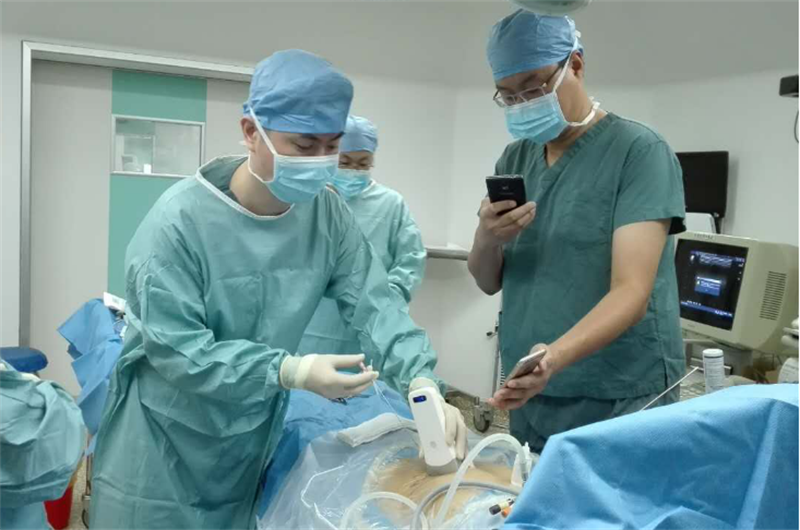
| Procedural guidance | Vessels/soft tissue visualized during access | Anesthesia, ER |
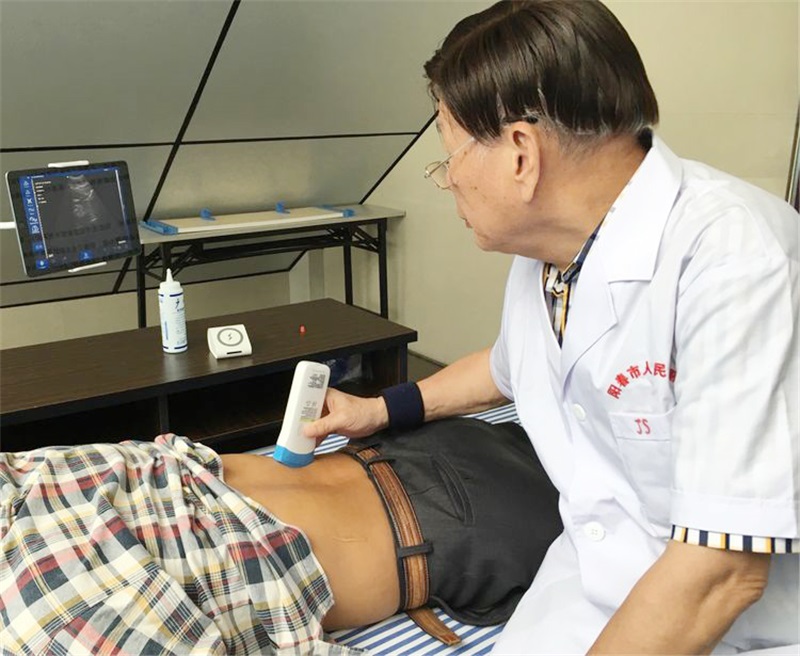
| Undifferentiated pain | Rapid triage before transfer | Outpatient, rural clinic |
These are "where is the patient right now" questions — the ones a scheduled scan cannot answer in time.
Why a Wireless Ultrasound Scanner, Not a Cart, Is the POCUS Tool
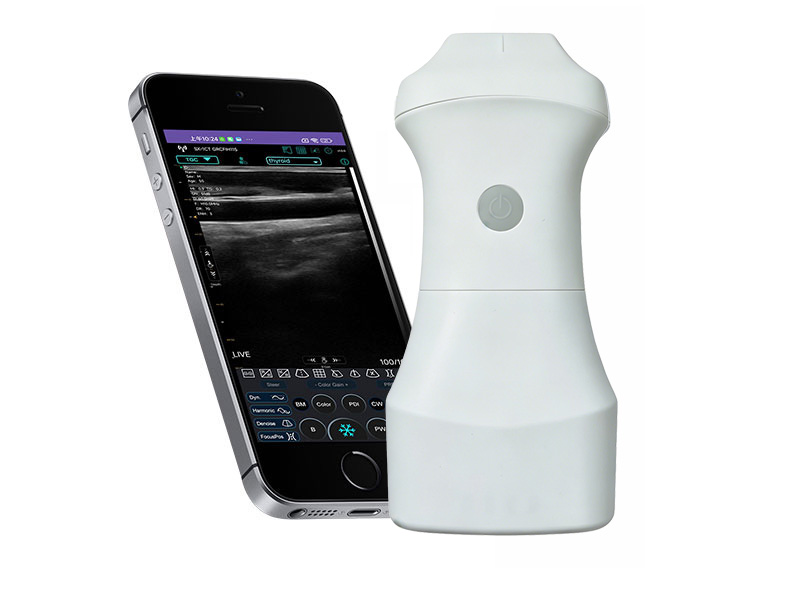
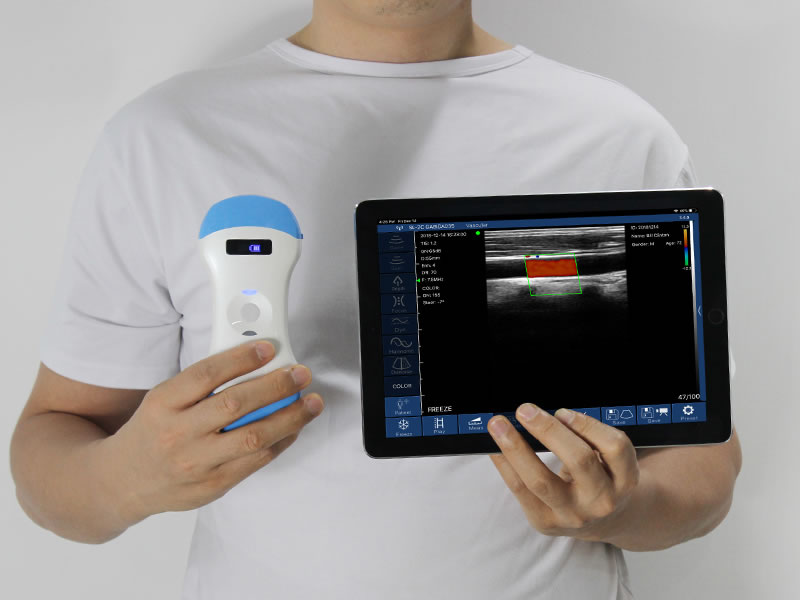
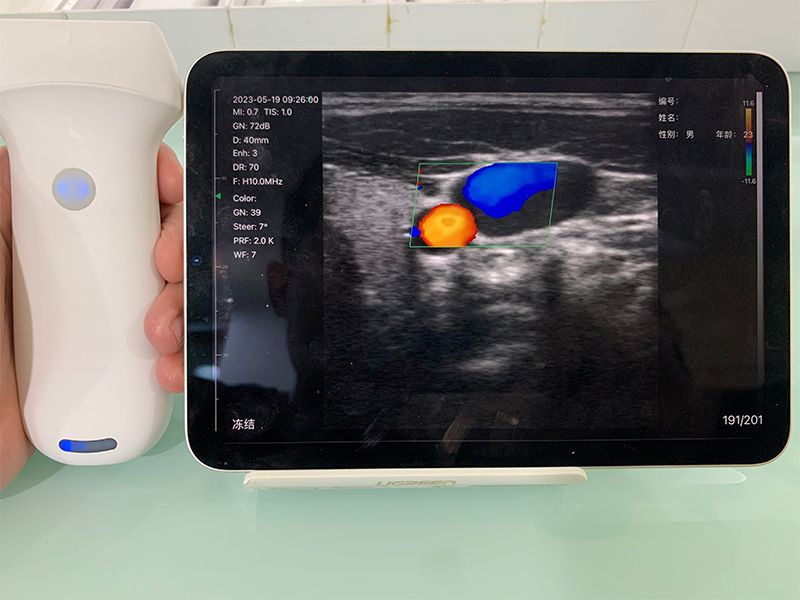
A cart cannot reach every bedside in seconds, and a cabled probe defeats the point. This is why the wireless ultrasound scanner has become POCUS's defining device: the probe is the machine, it opens and images in seconds, and the display is a phone or tablet the clinician already carries.
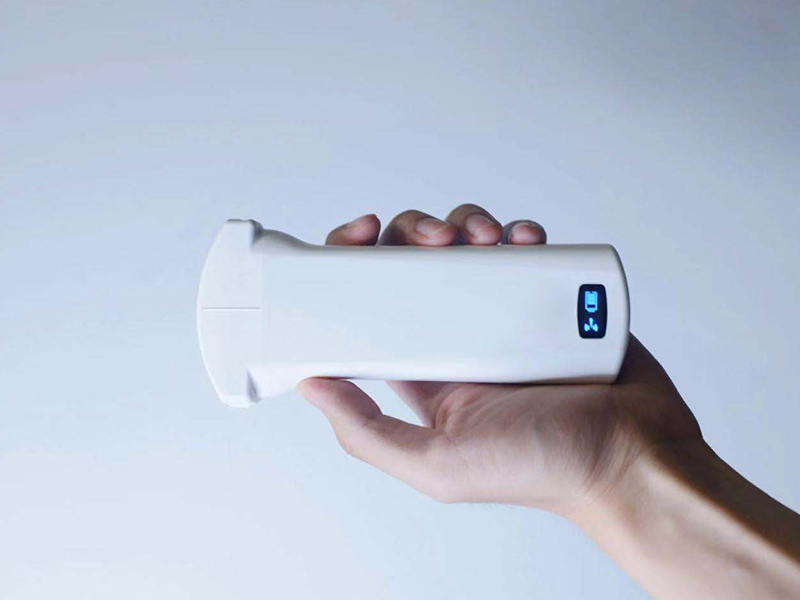
The engineering that matters at the bedside.The requirements are specific to bedside use. A dual-band 2.4/5 GHz Wi-Fi link (up to 450 Mbps) keeps color imaging smooth on a busy ward; a swappable 2200 mAh cell (about 1.5 hours each, shipped as a pair) turns a dead battery into a two-minute swap; and saving images as JPG, loops and DICOM means findings archive into a hospital system instead of staying on a personal phone. At about 230 g, it goes where the patient is.
The practical contrast with traditional equipment is the whole argument:
| Wireless handheld probe | Cart-based ultrasound | |
|---|---|---|
| Where it works | Bedside, ambulance, ward, field | Fixed scan room |
| Time to first image | Seconds | Minutes to set up |
| Patient transport | None | Often required |
| Best at | Focused, time-critical questions | Comprehensive, detailed studies |
| Role in POCUS | The primary tool | Backup for complex cases |
Who Is Using POCUS Now, and Its Limits
Adoption moved outward from its core: emergency, anesthesia and critical care lead, with internal medicine and primary care the fastest growers. A Chinese industry standard defines the same boundary conditions — in-hospital (emergency, rounds, ICU, intraoperative), out-of-hospital (pre-hospital, disaster, village clinics, family doctors, remote consult), and screening in resource-spread regions.
That said, POCUS is focused, not a full scan. It answers pre-defined questions quickly, depends entirely on trained operators, and refers complex findings to a cart-based study. Every handheld-ultrasound guideline frames it the same way: a focused, trained, bedside tool — not an end-to-end replacement.
Frequently Asked Questions
F1 :What is POCUS in one sentence?
Q1:Acquiring and interpreting a focused ultrasound image at the patient's side and acting on it immediately, instead of waiting for a scheduled radiology scan.
F2 :Is POCUS the same as a handheld or wireless ultrasound scanner?
Q2:No. POCUS is a way of working; the wireless ultrasound scanner is the pocket tool that made it practical.
F3 :Which specialties use POCUS most?
Q3:Emergency medicine, anesthesiology and critical care lead; internal medicine, primary care and procedural suites are growing fastest.
F4 Does POCUS replace the ultrasound department?
Q4:No — it complements it, with comprehensive and complex studies still performed by radiology.
F5 Can anyone use a POCUS device after a short demo?
Q5:No. Like all ultrasound, it needs structured training against a defined core set of applications.
Conclusion
The POCUS boom is the right tool at the right moment: urgent questions answered at the bedside, and a wireless ultrasound scanner that opens in seconds, streams to a phone, runs on swappable batteries, and saves DICOM-ready images. For institutions, adopt the focused-applications mindset, match the probe to those questions, and build training alongside the device. Explore SonoStar's wireless probe range — linear, convex, phased and 3-in-1 — built for POCUS workflows.
References
POCUS Market Analysis, Global Market Insights (USD 4.2B, 2025 → ~USD 9B, 2035; ~8% CAGR).
ACEP Emergency Ultrasound Guidelines (core applications, updated 2023).
Diagnostic Applications of POCUS in Emergency Medicine: Narrative Review. PMC12800864.
POCUS for Anesthesiologists in Perioperative and Critical Care. PMC11401632.
EFSUMB Position Paper on Handheld Ultrasound. 2019;40:e1.



 Home
Home Product
 News
News Contact